

Stay updated with our letter
Valuable perspectives on the latest trends and tips.
.avif)


5 Best Webflow Developers in the UK to Hire Now



Hiring a Webflow developer is easier when you look beyond the homepage of their portfolio. A polished screenshot shows visual taste. It does not show how the CMS works, whether the mobile navigation is accessible or how comfortably your team can update the site six months after launch.
This guide keeps the five names from our original shortlist and adds a more useful way to compare them: relevant work, technical fit, communication and handover. The best choice depends on your project. A developer supporting an established marketing team may need a different skill set from someone taking a new brand from its first brief to launch.
Editorial disclosure: Fit Design publishes this guide, and our co-founder Tomasz Lewandowski is included. This is a shortlist to support your research, not an independent ranking or a claim that we have tested every provider. Check current portfolios, availability and proposals directly before appointing anyone.
Start with three forms of evidence: comparable live work, an understandable implementation and a usable handover. Together, they show whether the developer can deliver the site your visitors need and leave your team able to operate it. Treat the portfolio as an invitation to investigate those details.
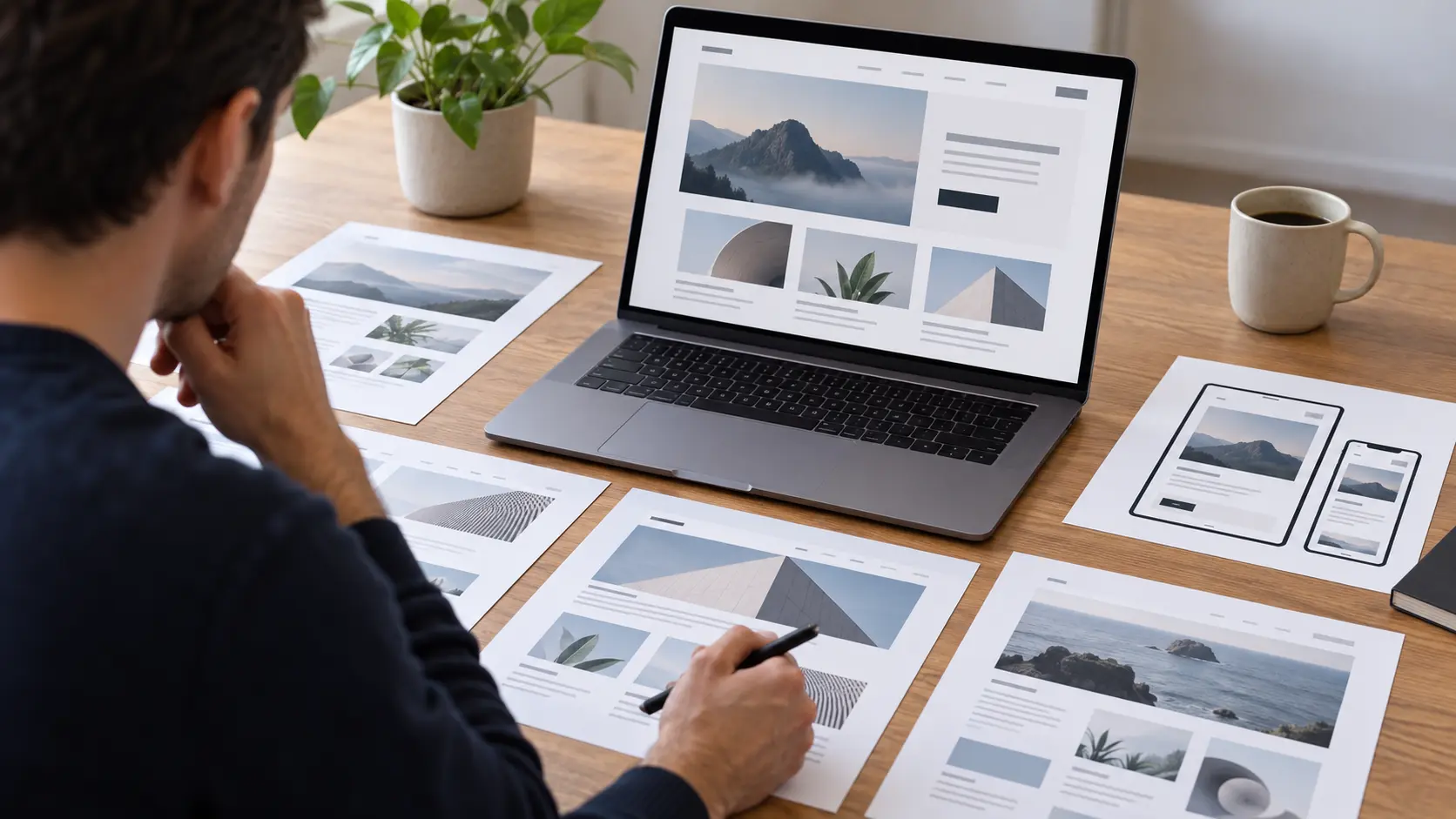
What a good Webflow developer should deliver
Webflow provides a visual development environment, but a professional result still depends on decisions about structure, responsive behaviour, content and interactions. The work involves more than placing blocks on a canvas. It includes turning a design into a website that behaves consistently and remains practical to maintain.
Ask to see how a representative page is built. Reusable components should serve a clear purpose, CMS fields should make sense to an editor, and classes should follow a consistent convention. There is no single class system every developer must use, but another competent developer should be able to understand the implementation.
Also discuss the boundary between native Webflow functionality and custom code. A small script may solve a genuine requirement efficiently. An unnecessary collection of scripts can make a straightforward marketing site harder to support. The important question is why the dependency exists and who will maintain it.
Relevant evidence also needs context. Ask what the developer personally delivered, which decisions belonged to another team and what changed after the original launch. This distinguishes a useful example from an attractive site that no longer reflects the implementation you are assessing.
Five Webflow developers to consider
1. Tomasz Lewandowski — Fit Design
Tomasz is the co-founder and lead designer at Fit Design. Our Webflow development work brings approved designs into editable websites, with attention to responsive layouts, CMS structure and the details that influence how clearly visitors understand a business. This makes the discussion especially relevant when design and implementation need to work together.
When assessing Fit Design, ask for projects comparable to your own scope and the responsibilities covered within each one. A full redesign, a Figma-to-Webflow build and ongoing improvements require different deliverables. Establish which work is included before comparing the proposal with a freelancer offering development alone.
Use the Fit Design website and relevant project pages as the starting point for that review. Ask how the site will be handed over, what your editors can change and how questions are handled after launch. These are more useful decision criteria than a promise of unlimited creativity or perfect results.
2. Ethan Suero
Ethan's public Webflow portfolio includes projects such as Plover Parametrics and Veloce Media Group. The descriptions identify work involving design and Webflow implementation, including collaboration with an existing design team. Review the individual project descriptions to understand his role rather than assuming every part of every site was created by one person.
For a project with several stakeholders, ask how he manages design feedback, approvals and changes during development. If your company already has a designer, clarify whether you need implementation only or help refining the design for responsive behaviour and CMS content.
His Webflow profile provides a direct route to the public work. Bring a short brief and a representative design when discussing fit. That will produce a more meaningful conversation than asking for a price for an undefined “modern website”.
3. Scott Humphrey — Humphrey Studio
Scott's studio describes a focus on Webflow design and development, supported by a broader creative and marketing background. Its public support offering also makes it relevant to businesses that already have a website and need improvements rather than a complete rebuild.
For ongoing support, ask how requests are prioritised and how the studio handles an unfamiliar existing build. An initial review of classes, components, integrations and custom code can be important before committing to a fixed change estimate. Good discovery helps avoid repeatedly fixing symptoms without understanding their source.
Review Humphrey Studio's Webflow support information and request comparable examples. Confirm the current working arrangement and who will perform the work, particularly if your marketing team expects frequent communication or reserved development capacity.
4. Derrick Kityo
Derrick's own website presents work across websites, apps, product marketing and SEO. His public Webflow work also includes examples involving maintenance. That breadth may be relevant when a website sits within a wider set of tools and marketing activities.
If your project includes integrations, ask for a clear explanation of the proposed architecture. Identify which system stores each type of information, what happens if a connection fails and who owns the accounts. A visually strong site still needs a dependable route from a visitor's enquiry to the team responding to it.
Use Derrick's website to review the current offering. Discuss the specific platform requirements rather than assuming every app or automation can be delivered natively in Webflow. The right proposal will explain both the fit and the limitations of the chosen approach.
5. James Newland — Wider
Wider's own website identifies James Newland as its creative director and presents a broader design practice. For a business whose website needs to align with brand development, that wider creative context may be useful. Confirm how Webflow delivery fits within the proposed team and scope.
Ask to see a recent project where the studio handled both brand expression and the practical website build. Look for consistency across typography, imagery and content hierarchy, then test the live experience on a phone. Brand consistency should make the site easier to understand, not just more distinctive in a presentation.
The Wider studio information is a starting point for due diligence. Request current examples, availability and the names or roles of the people responsible for development and handover. A creative director's involvement does not automatically mean they will perform every implementation task.
| Developer / studio | Starting point | A useful question |
|---|---|---|
| Tomasz / Fit Design | Design and editable Webflow delivery | Which comparable project shows the scope we need? |
| Ethan Suero | Public design and Webflow projects | How do design feedback and build approvals work? |
| Scott / Humphrey Studio | Webflow design and ongoing support | How do you assess and maintain an existing build? |
| Derrick Kityo | Websites, apps and marketing work | How will the integrations be owned and supported? |
| James / Wider | A broader creative design practice | Who is responsible for Webflow delivery and handover? |
Caution: Discussion prompts based on the linked public profiles. Not an independent ranking; Fit Design publishes this guide. On smaller screens, swipe the comparison sideways.
Three things to inspect in a portfolioHow to compare portfolios properly
Choose two or three examples relevant to your project and examine the live pages. Read a long heading, open a menu, follow a call to action and inspect how content reflows on a smaller screen. Look beyond the hero: service pages, forms and CMS templates often reveal more about build quality.
Ask what the developer was responsible for. A project may involve a separate brand studio, copywriter, designer and developer. Honest attribution helps you understand which capabilities you are actually buying. It also prevents an attractive project from becoming evidence for a skill the provider did not deliver.
For CMS work, ask to see an ordinary editing task. Can a team member add a case study, change a service description or replace an image without adjusting layout settings? A short demonstration is more persuasive than a generic claim that the website is “fully editable”.
A polished screenshot shows visual taste. It does not show how the CMS works.Design references are not a hiring test
Our original reference list includes Ready, Ujet , The Goonies, Donuts and Chiara Luzzana. These links can prompt discussion about composition and interaction, but a reference site is not proof that one of the shortlisted developers built it. Nor should a current platform be inferred solely from its inclusion in an older article.
Explain what you like about each reference. It may be the clarity of the navigation, the pacing of a case study or a particular interaction. That gives the developer a useful brief without asking them to reproduce an entire unrelated site. A highly animated showcase may be an inappropriate model for a content-heavy professional services website.
Our Livit project provides another point of discussion. Evaluate any reference against your audience and content requirements. A good developer should be able to explain when a visual idea helps your goals and when a simpler implementation is more suitable.
Freelancer or Webflow agency?
A freelancer can offer direct communication and continuity with the person building the site. This often suits a focused scope, particularly when strategy, copy and design are already prepared. Ask how holidays, urgent issues and work outside their specialism are covered.
A Webflow agency may bring several disciplines together and provide broader delivery capacity. That can be useful when the project includes discovery, design, content and development. However, an agency label does not tell you who will do the work or how much senior involvement you will receive. Ask those questions directly.
Compare like-for-like proposals. Development from approved Figma files is different from creating the strategy and design first. A lower quote may simply exclude content population, migration, responsive design decisions or post-launch support. Make those differences visible before deciding which offer represents value.
| Consideration | Freelancer | Agency |
|---|---|---|
| Working relationship | Usually direct contact with the specialist | Ask who manages and performs the work |
| Scope | Often suits a focused brief with prepared inputs | May coordinate several disciplines |
| Continuity | Clarify holidays and urgent cover | Clarify team continuity and senior involvement |
| Fair comparison | Check excluded specialist tasks | Check what the wider fee actually includes |
Choose based on the proposed team and scope, not the label. On smaller screens, swipe the comparison sideways.
Worked example · hypothetical
A portfolio match is not always a scope match
Imagine a business comparing two developers who both show excellent marketing websites. One quote assumes approved desktop and mobile designs, supplied copy and a straightforward CMS. The other includes designing those layouts, preparing content templates and migrating the existing articles. The higher total may reflect different responsibilities rather than a higher price for identical work.
Ask both providers to separate the same deliverables: design decisions, build, content population, migration, testing and handover. Then discuss any exclusions or dependencies. A useful comparison explains who will do the work that is missing from the lower quote, rather than assuming it will happen somewhere during the project.
The same reasoning applies to support. A defined defect-correction period is different from an ongoing allocation for new features. Confirm what is included, when the arrangement ends and how additional requests are estimated. This example is a planning exercise, not a claim about any shortlisted provider’s contract.
What should be in the project scope?
Describe the number of unique page layouts, CMS collections, important integrations and content that needs migration. Ten pages built from one reusable layout are different from ten individually designed experiences. Page count alone is a weak basis for estimating development effort.
Specify who supplies copy, images and fonts, and who approves each stage. Identify the existing URLs that must be retained and any tracking or integrations that must survive the redesign. Include accessibility expectations and the devices or viewport ranges used for review.
Agree how additional requests are handled. A practical process identifies the effect on cost and timing before work begins. This protects both parties and makes it easier to distinguish a defect from a new feature added after approval.
Put the editing boundary into the brief
List the page types, CMS collections, supplied assets and integrations, then describe who manages each after launch. An editor may be able to change a service description or add a case study without being able to redesign the template. Neither arrangement is inherently wrong, but it needs to match the way your team works.
Include one unusual content example in the demonstration: a long project title, a missing optional image or a detailed service description. These reveal whether the editing model protects the layout when the content is less tidy than the portfolio example. Ask what guidance your team receives for those situations.
Testing, SEO and launch readiness
Useful SEO optimization begins with clear content, sensible structure and a technically accessible site. It should not be reduced to filling in metadata fields. Ask how the developer handles headings, internal links, image descriptions, indexing settings and any existing URL mappings.
Testing should cover the actual user journeys. A form needs labels, usable error states and confirmed delivery. A menu needs to work with keyboard input and on touch screens. Motion should not prevent people from reaching content or using the site comfortably.
Before launch, review a representative page and then check the remaining templates and important edge cases. Long CMS titles, missing optional images and unusually large content entries can reveal problems that a carefully curated demo misses. Ask how these cases are included in quality assurance.
Handover and ongoing maintenance
A useful handover explains account ownership, the editing workflow and any custom dependencies. It should identify where content lives, how to publish changes and which settings editors should avoid changing without support. A short recording based on your own site can be more valuable than a generic platform tutorial.
Discuss ongoing maintenance separately from the initial build. Clarify which defects are covered after launch, what counts as a new request and how support is arranged once the initial period ends. Do not assume a specific warranty or response time unless it appears in the agreed proposal.
Keep domain, platform and connected-service access organised under the business. The relationship should remain workable if staff or suppliers change. A maintainable website is one that another qualified person can understand without reverse-engineering undocumented decisions.
Learning Webflow versus hiring a specialist
Webflow University is a useful starting point for understanding the platform and learning everyday editing. That knowledge can make you a better client even if you never intend to develop the site yourself. You will be more comfortable discussing CMS structure, reusable components and publishing responsibilities.
Building a professional site also requires judgement about design, content and testing. Allow for that learning time when comparing DIY with outsourcing. A course demonstrates exposure to a tool; a relevant, well-explained project demonstrates how someone applies their skills.
Similarly, a developer's salary is not a project estimate. A supplier's fee must cover discovery, delivery, communication, overheads and the agreed support. Ask for a scoped quote instead of translating an annual salary figure into an assumed hourly rate for your project.
A workable approval sequence makes the brief concrete before the entire site is built. Agree the responsibilities first, develop one representative page, review its content and behaviour, then extend the approach. If the sample exposes an unclear assumption, resolve it before that assumption is repeated across every template.
Make the final decision with a representative example
Before extending a build across the entire site, agree a representative page that includes the real typography, CMS content and key interactions. Review it at desktop and mobile widths. This makes expectations concrete and surfaces disagreements while they are still inexpensive to resolve.
Choose the partner who can explain the implementation, demonstrate relevant work and define responsibilities clearly. A strong working relationship is built on that evidence. The result should be a website your visitors can use and your team can confidently maintain, not merely a portfolio image that looks impressive on launch day.
Review relevant live projects, ask what the developer delivered and request a demonstration of an ordinary editing task. Compare the proposed scope, testing and handover, not only portfolio appearance. The best fit depends on whether you need design, implementation, migration or ongoing support.
A freelancer can suit a focused project with prepared inputs. An agency may be useful when several disciplines need coordination. Neither structure guarantees quality. Compare who will do the work, the responsibilities included and how continuity is handled.
It should be possible to manage the content agreed in the scope through suitable CMS fields and editing workflows. Ask for a demonstration using your own content. Some structural or functional changes may still require a developer, so establish that boundary during planning.
No platform guarantees search performance. Content relevance, technical implementation, internal links and competition all matter. The build should provide a sound foundation, with accurate metadata and accessible content, while ongoing SEO requires its own work and evaluation.
Provide the audience, page types, CMS requirements, integrations and any approved designs or existing website. Explain who supplies content and which URLs must remain. A representative page and a clear deadline make the estimate more useful.


.webp)
Where ideas come to life
We explore various aspects of modern life, offering valuable perspectives on the latest trends, and helpful tips.

