

Stay updated with our letter
Valuable perspectives on the latest trends and tips.
.avif)


The £8,000 Mistake: Audited 40 London Restaurant Websites


Key takeaway: Our audit of 40 London restaurant websites found that unreadable menus and weak booking journeys create avoidable losses in search visibility and revenue.
We audited the websites of 40 of London's best restaurants across Soho, Shoreditch, Covent Garden and Borough. Ten per neighbourhood. Bib Gourmand, Michelin stars, National Restaurant Award winners. Places that have shaped how Londoners eat for three decades.
The findings, in one paragraph: the food is brilliant but the websites are not. 29 of the 40 restaurants publish their menus in a format that's effectively invisible to Google's AI Mode, ChatGPT, Perplexity, voice search, and especially to the modern diner's pre-booking habit of asking their phone "where should I eat tonight?"
Only eleven publish the menu as a webpage Google can actually read. Two of those are also publishing PDFs alongside the HTML - the only "belt and braces" examples we found. This is the most fixable problem in London hospitality and also the one almost nobody is fixing.
Audit Results of Restaurant Websites in London
A snapshot of what we found across the 40 restaurants:
📋 Menu Format Breakdown
- 25 restaurants serve their menu as a PDF (62.5%)
- 9 restaurants use proper HTML menus (22.5%)
- 2 restaurants run a Hybrid HTML+PDF setup — Rules and The Anchor & Hope (5%)
- 2 restaurants use images of handwritten menus — Andrew Edmunds, Casse-Croûte (5%)
- 1 restaurant uses a JavaScript pop-up modal — ZIMA (2.5%)
- 1 restaurant redirects to Instagram — 40 Maltby Street (2.5%)
-------------------------------------------------------
📊 Performance & Speed
- Average mobile Performance score: 53/100 (Google flags below 50 as "poor")
- 17 of 40 sites (42.5%) score under 50 on mobile Performance
- Slowest time to menu on 4G: 14 seconds (ZIMA)
- Average time to menu: 7.1 seconds — diners typically abandon at three
- Fastest site: Kiln (Performance 96, but the site itself is essentially dormant since 2020)
-------------------------------------------------------
🎯 SEO & AI Readiness
- 19 of 40 sites (47.5%) have no schema markup at all
- 0 of 40 sites have Menu schema (the structured data Google needs to read menu items)
- 23 of 40 sites have weak, missing, or broken meta descriptions
- 5 sites are running technical issues serious enough to materially damage their search visibility — broken pages, placeholder text shipped to production, deployment errors visible to every visitor
-------------------------------------------------------
🗣️ Reputation Gap
- Average Google review score across the 40 restaurants: 4.48 out of 5
- That's the food, but how about the Core Web Vitals website performance: 53 out of 100 on mobile
- 17x restaurants have a 4.6+ Google review and a Performance score below 60
That last gap is the one that should keep restaurateurs up at night. The food, the atmosphere and the area is brilliant. The website is selling it short!
🧱 Closures During the Audit
- 5 restaurants closed during the six-week audit window: Lyle's, Pidgin, Andina, Frenchie, Margot
- That's a 12.5% closure rate in six weeks — a useful reminder that London hospitality runs on tight margins, and lost bookings really matter
-------------------------------------------------------
What's the £8,000 London Restaurant Mistake Exactly?
We're not going to pretend the number is precise — it's an estimate, based on industry data and the restaurant economics most readers will recognise.
Take a mid-tier London independent restaurant doing dinner service:
- 80 covers per night × 6 nights per week × 50 weeks = 24,000 covers/year
- Average spend at this audit's tier: £55 per head
- Annual revenue at full occupancy: £1.32M
Now the friction:
Google's own research shows 53% of mobile users abandon a page that takes longer than three seconds to load. Our average time-to-menu across the 40 restaurants was 7.1 seconds, but the worst was 14 seconds.
Industry data on restaurant website abandonment when the menu is a slow PDF, an unreadable image, or hidden behind clicks puts conservative booking loss at 1–3% of would-be diners.
Apply that conservatively to the example above:
- 1% lost bookings × 24,000 covers × £55 = £13,200/year
- 0.6% lost bookings × 24,000 covers × £55 = £7,920/year
£8,000 is the conservative end in my opinion. For a busy Soho restaurant with 100+ covers/night and a £65 average spend, the same calculation pushes past £15,000/year. For a London Michelin restaurant charging £275/head where every cover counts even more, the loss compounds further.
We're not counting the bookings that never happen because the AI assistant didn't surface the restaurant in its answer. That's a bigger number again, but harder to measure. We'll leave it out and stick with the £8k figure as the floor.
The point isn't the exact figure. The point is that for every restaurant in this audit with a PDF menu, an image menu, or a pop-up, the bookings that didn't quite materialise this Tuesday — and last Tuesday, and the Tuesday before — add up to a number that pays for an entire website rebuild several times over within a year.
What Did We Analyse & Measure?
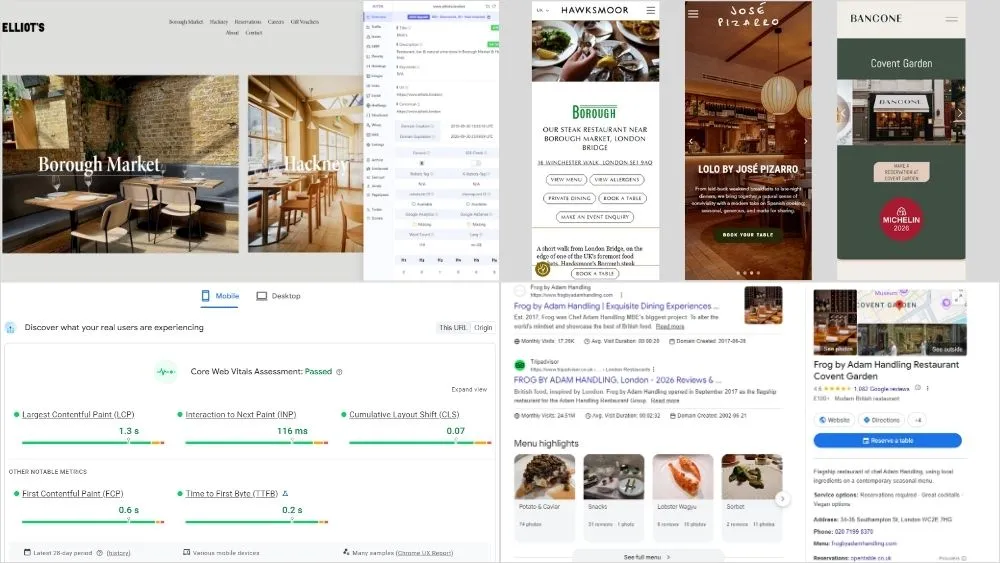
We did the thing every restaurateur should do at least once a year. We pretended to be hungry, on a phone, walking down the street, deciding where to spend £80 - £100 on dinner. We tried to read the menu, tried to book a table, and timed it.
🔎 Data Recorded - Step 1 - Technical SEO
- H1 tags, meta titles, meta descriptions
- Canonical URLs, Open Graph images
- Schema markup type
- Robots.txt allowance for Googlebot
- JavaScript-dependent content
- Image alt text quality
- CMS/platform identification
-------------------------------------------------------
🔎 Data Recorded - Step 2 - Mobile Experience
- Time to menu (in seconds, on 4G)
- Mobile LCP (Largest Contentful Paint)
- Persistent booking button on scroll
- Menu schema, dietary icons
-------------------------------------------------------
🔎 Data Recorded - Step 3 - PageSpeed Insights (mobile)
- Performance
- Accessibility
- Best Practices
- SEO Score
-------------------------------------------------------
🔎 Data Recorded - Step 4 - Editorial Assessment
- Lead score (1–5, how strong a conversion candidate)
- Notes on design, UX and story
- Google review score (the food benchmark)
Our 10 Soho Restaurant List
Soho is the densest restaurant neighbourhood in our audit. Frith Street, Brewer Street, Dean Street and Archer Street between them carry six restaurants we audited.
The age range is huge — Bocca di Lupo dates to 2008, Quo Vadis to 1926, BAO Soho to 2015. The mix of tourists, theatre and local trade pushes restaurants to publish heavily. Most don't.
Soho Summary: 8 of 10 restaurants on outdated platforms or formats. Two success cases (BAO, Barrafina) and both run on bespoke technical stacks built by people who knew what a menu should be. The Hart Brothers ownership case is telling — the same group runs Quo Vadis (PDFs) and Barrafina (HTML). Same money, same agency relationships, different decision per brand.
Our 10 Shoreditch Restaurant List
Shoreditch is younger and more design-conscious than Soho. The mix is wider: gastropubs (Smoking Goat, Brawn), tasting menus (Clove Club), modern British (Rochelle Canteen), regional Thai (Som Saa) and Michelin-starred destinations (Brat).
The neighbourhood produced four sister-restaurant clusters: Super 8 group (Kiln + Smoking Goat + Brat), the Quality Chop House (Woodhead Restaurant Group), and one substitution after Lyle's closed in May 2025.
Shoreditch Summary: 3x HTML successes (Barrafina-style menus at Café Cecilia and Rochelle Canteen, plus partial credit to Brawn for its journal). 7x PDF or hybrid failures. The pattern that emerges most clearly here is the agency doesn't matter finding — every Shoreditch agency we encountered shipped both PDF and HTML sites for different clients.
Our 10 Coven Garden Restaurant List
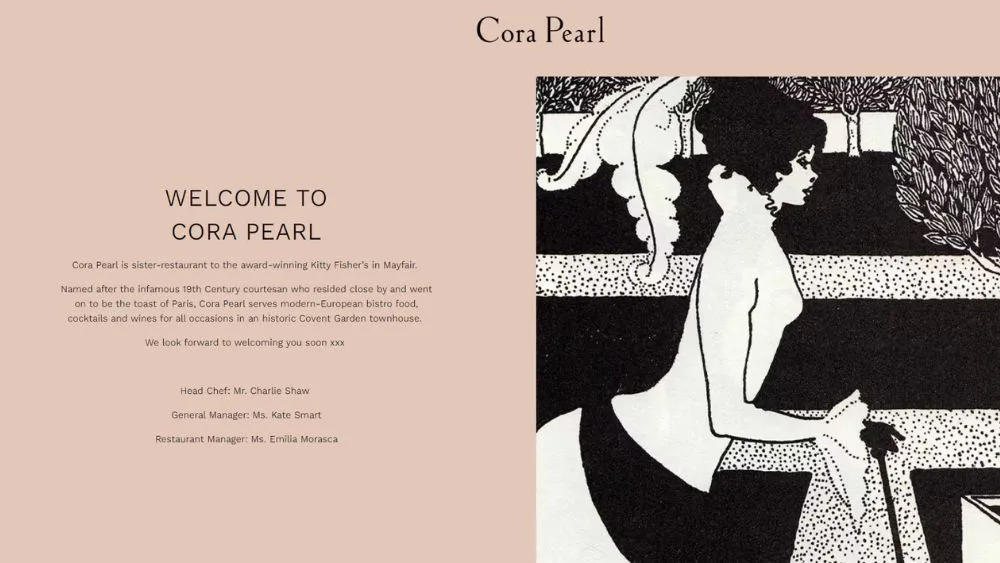
Covent Garden is the most tourist-heavy section of our audit and has the widest age range. Rules has been open since 1798 (the oldest restaurant in London). Frog by Adam Handling and Cora Pearl opened post-2017.
The neighbourhood has more Michelin stars per square metre than any other section in our audit. It also has the most chain-template restaurants (The Ivy Collection, Bancone, Balthazar via Caprice Holdings).
Covent Garden Summary: 4x HTML successes (Cora Pearl, Spring, The Ivy West Street, Rules-as-hybrid). The best-designed site in the audit (The Ivy) sits next to one of the most minimal (Sessions Arts Club). The pattern that emerges is the story gap: tourist-heavy restaurants have the most to gain from telling their story online, and almost none do.
Our 10 Borough Restaurant List
Borough is the most food-focused neighbourhood in our audit. Most diners arrive after walking through Borough Market and have already made a decision. This puts unusual pressure on the website to seal the booking rather than discover the restaurant.
The neighbourhood has the most pubs-turned-restaurants in our audit (The Garrison, Anchor & Hope) and the highest density of small independents.
Borough Summary: 3x HTML or hybrid successes (Padella, Hawksmoor, Anchor & Hope). The most pronounced "missing story" pattern in the audit — Borough restaurants live and die by walk-in passers-by from the market, and the websites are doing little to win them back home as future bookings.
Top 5 Restaurant Failure Patterns Found
After 40 audits, the failure modes cluster into a clear hierarchy. Each tier is worse than the last for being discovered, indexed, and quoted by the systems most diners now use.
🔥 Tier 1: Self-hosted PDF
25 of 40 restaurants do this. The menu is a PDF file on the restaurant's own server, linked from the menu page.
- PDFs are technically indexable by Google. In practice, they rank poorly, load slowly, and rarely appear in AI-generated answers
- They can't be styled for mobile, so the diner pinches and zooms if they can open it
- The bounce happens before the booking does
NOTE: One Soho restaurant — Bocca di Lupo — regenerates its PDF daily. The chef rewrites the menu every morning, the file is uploaded fresh, and the URL stays the same. Operationally, it's admirable. Search-wise, it's invisible. The same workflow, redirected into an HTML page, would solve everything.
-------------------------------------------------------
🔥 Tier 2: External PDF, Modals and Pop-ups
ZIMA routes the menu link through a JavaScript pop-up that then opens a PDF in a separate Google Drive tab — five clicks and 14 seconds before the diner sees a dish. Hoppers Soho opens its menu PDF in Google Drive for download.
- Both fracture the brand (the diner leaves the restaurant's domain)
- Both add seconds to the journey
- Both make the menu content effectively unreachable to crawlers
NOTE: Our slowest time-to-menu was 14 seconds. Fourteen. The next slowest was 13. Most diners are gone by 5s.
-------------------------------------------------------
🔥 Tier 3: Image of a Handwritten Menu
Two restaurants photograph their chalkboard each morning and upload the image. Andrew Edmunds in Soho uses a handwritten PNG. Casse-Croûte in Bermondsey posts the menu as an Instagram image embedded on the homepage.
- The aesthetic is intentional. The result is that the dishes — beautiful, characterful — exist nowhere as text
- Not for Google. Not for an AI assistant. Not for a screen reader
- For visually impaired diners using accessibility software, the menu is literally inaccessible. That's an Equality Act concern dressed up as a design choice
-------------------------------------------------------
🔥 Tier 4: External Platform Redirect (Instagram)
40 Maltby Street has, on its homepage, a button labelled "view menu." Click it. You leave the website entirely. You land on Instagram.
- Every menu update generates engagement on Meta's platform, not the restaurant's
- The diner who doesn't use Instagram — or can't, because they're on a corporate network that blocks it — has no way to see what's on tonight
- The restaurant has, without realising it, handed its menu over to a company that owes it nothing
-------------------------------------------------------
🔥 Tier 5: Nothing at All
One restaurant — José Tapas Bar on Bermondsey Street — publishes its food menu only on the chalkboard inside the dining room. No online version. No PDF, no image, no Instagram link. Just opening hours and a phone number.
This is rare. But it exists. In London. In 2026. On the website of a critically beloved Spanish restaurant.
The Deeper Problem Nobody is Talking About
If we stopped writing here, this would be a piece about menu formats. It's not. The menu is just the most measurable failure. The deeper one is harder to put a number on, and it became obvious somewhere around restaurant fifteen.
Almost none of these websites tell you anything about the restaurant. Between the 40 places we audited, the cumulative history runs to several centuries:
- Rules has been serving Londoners since 1798 — open through the Napoleonic Wars, both World Wars, twelve monarchs, the Spanish Flu, and Covid
- Quo Vadis opened in 1926 — Karl Marx lived in the building above it
- The Quality Chop House has operated since 1869
- Quaglino's [not in this audit] dates to the 1920s
Other restaurants on the list have:
- Held Michelin stars for 16+ years (Galvin La Chapelle)
- Been named the UK's #1 restaurant (Kiln, 2018)
- Featured on the World's 50 Best Discovery lists (40 Maltby Street)
- Raised public funding to crowdfund expansions (Som Saa)
- Been photographed by some of the best food photographers in Britain — David Loftus (Hoppers), Matt Austin (The Garrison), Sam Harris (The Quality Chop House), Steven Joyce (Bocca di Lupo), Benjamin McMahon (Brat), John Carey and Tom Cockram (Brawn)
The websites do not mention almost any of this. The "about" pages, where they exist, are usually three sentences long or do not have adequate copy. The photography, where it exists, is hidden three clicks deep.
The named chef, if named at all, appears on a separate page that isn't linked from the homepage. The history — and these are restaurants with enormous histories — is absent.
-------------------------------------------------------
A diner arriving at one of these websites today learns:
The address. The opening hours. A button to book a table [if available] - that's it.
- No description of what makes the place feel different
- No photographs or video of the room at service, full of warm light and clinking glassware
- No photographs of the food beyond the occasional decorative shot, often with no caption
- No biographical paragraph about the chef, the founder, or the family that's been running the kitchen since 1798.
This is strange because the restaurants themselves are anything but anonymous. Walk through the door and you understand instantly what they are — the smell, the noise, the light, the regulars at the bar who haven't moved in fifteen years. The character is overwhelming. None of it makes it to the website.
Somewhere around 2014, a design philosophy seems to have taken hold across London hospitality that a restaurant website should be a minimalist business card:
- Logo
- Address
- Hours
- Book button
- PDF menu
- Deco Images
The philosophy has not aged well. A restaurant website in 2026/27 is also a place where Google's AI now reads to answer questions like "where should I take my parents in Clerkenwell for their anniversary?" A minimalist business card doesn't answer that question. It just sits there.
The restaurants aren't selling themselves short on purpose. They've just stopped looking at the website that's selling for them because they might be busy or simply it's not a priority... until the covers drop! For most restaurants in this audit, that's not a rebuild conversation — it's a brand refresh conversation.
-------------------------------------------------------
11 Exclusive Restaurants Getting Menus Right
Eleven restaurants in our audit have HTML or hybrid menus that work properly for the modern internet:
What these eleven have in common:
- They publish the menu as a webpage, not a download — dishes have descriptions, prices, and sometimes named ingredients
- The menu URL is structured properly —
/menus/a-la-carte, not/uploads/menu-final-v3.pdf - The menu page is updated, dated, indexed — Google sees a real page, not a binary file
- The booking button works on every page — not just the homepage
- The platform is irrelevant — five different CMSes appear in this list
What unites them is the decision, not the technology. Three are on WordPress. Two on Next.js. One on BentoBox. One on the Ivy Collection's bespoke platform. One on Webflow doesn't appear here, but you'd expect it to.
The youngest restaurant in this list (BAO Soho, 2015) and the oldest (Rules, 1798) both solved the same problem. The platform isn't doing the work. The decision is.
-------------------------------------------------------
What You Should Know About The Solution?
Here's the part that's actually fixable. If you run a restaurant and you've read this far, here's the short version.
Five things to check on your own site:
1. Open your site on your phone. Time how long it takes to reach the menu. If it's over 7 seconds, you have a problem. If you have to pinch to zoom on the menu PDF, you have a bigger one.
2. Look at the title bar of your homepage. Open the page in a PC browser and check the tab at the top, or right-click and view source and search for <title>. If it says "Home Page" or "Untitled" or just your restaurant's name with no descriptor, you've found a free upgrade.
3. Read your meta description. Search your restaurant's name on Google. The line of text underneath the title is your meta description. If it's missing, generic, or stuffed with keywords, change it.
4. Check your menu's URL. If it ends in .pdf — or worse, if it redirects to Google Drive, Instagram, or anywhere not on your own domain — you have a project to commission.
5. Look at one photograph of your food on your website. Right-click and inspect the image. Find the alt attribute. If it's empty, or it says random characters like IMG_1203 or tempImage9EmEZV, your photographer's work is doing none of the AI-search work it should be doing.
If any of those tests came back red, the question to ask your web developer this week is:
If a diner walked up to our window and asked their phone 'what's on the menu tonight here?', would the phone be able to answer?
If they can't say yes, that's the project to commission next.
-------------------------------------------------------
The Longer Fix List
If you've got more bandwidth than five minutes:
1. Move the menu out of the PDF. Even if the PDF stays as a downloadable backup, the canonical menu should be a webpage with proper headings, sections, and prices.
2. Add schema markup. At minimum, LocalBusiness and Restaurant. Ideally, Menu schema for each menu page.
3. Write your "About" page like a magazine profile. Who runs the kitchen. When you opened. Why. What you're trying to do.
4. Record an intro video and photograph the room and the food. Then write proper alt text for every image. "Bone marrow varuval with paratha" is good. IMG_4821.jpg is not.
5. Add named author bylines to any editorial content — chef notes, journal entries, "this week" updates. E-E-A-T signals matter for AI citation.
6. Make the booking button persistent — sticky on every page, visible without scrolling.
7. Set max-image-preview: large in your robots meta — single line of code, makes you eligible for Google Discover image cards.
8. Optimise the site for mobile scrolling. Most of your traffic is from phones, and most of your booking decisions are made there. Don't just rely on Google Maps and restaurant review platforms to do the heavy lifting.
9. Write proper SEO meta titles and meta descriptions for every page. Each page should have its own title (50–60 characters) and description (120–160 characters) that tells Google and the diner what's on it. "Home Page" doesn't count. Neither does your CMS's placeholder helper text.
10. Add an FAQ section that answers the questions diners actually ask. "Do you serve halal? Are you open on Sundays? Is there a vegetarian tasting menu? Do you take walk-ins?" Direct Q&A is the format AI assistants love to quote — and the one search engines love to surface as featured snippets. One afternoon's work, ongoing visibility.
-------------------------------------------------------
What This Means For Us & For You?
We're an agency. We build bespoke Webflow websites for restaurants and we're obviously biased. So the next paragraph is the one to read sceptically.
The conclusion we've drawn from this audit — looking at 40 restaurants we admire enormously — is that most of London's best restaurants are silently undersold by the digital infrastructure they built five years ago. The good news is that the fix is not, in most cases, a new website.
The fix is a conversation about what the website is for in 2026, followed by a few weeks of focused work to bring the menu, the restaurant story, the rooms, and the chef into a format the modern diner — including the AI doing the searching for them — can actually find.
If you'd like that conversation, we're here. If you'd rather just take the audit checklist above and run it on your own site, we'd be delighted by that too. The restaurants we audited aren't our clients. None of them paid for any of this. We did the work because the gap between what these places are and what their websites say they are was getting too big to ignore.
The website is the front door now. Most of the front doors on Frith Street, Bermondsey Street, Henrietta Street and Redchurch Street are quietly ajar — not closed, not welcoming, just slightly off.
If your menu is published as a PDF, an image, or behind a JavaScript pop-up, Google often can't index it properly. PDFs rank poorly, images aren't readable as text, and pop-up modals are invisible to crawlers. The fix is to publish your menu as an HTML webpage with proper headings, sections, and prices — that way Google, AI assistants, and voice search can actually quote it.
Conservatively, around £8,000 per year for a mid-tier London independent. The calculation: roughly 24,000 covers per year at £55 average spend, with industry data suggesting 0.6-1% of would-be bookings are lost to website friction (slow load times, hard-to-find menus, broken booking flows). Larger or higher-spend restaurants lose more — £15,000+ per year isn't uncommon.
There's no single best CMS — what matters is whether the platform allows your menu to be published as crawlable HTML rather than a PDF. In our audit of 40 London restaurants, HTML menus appeared across Webflow, WordPress, Next.js with Sanity, and BentoBox. Squarespace and Wix produced PDF menus across every site we audited.
Run five quick tests on your phone: time how long it takes to reach the menu (over 4 seconds is too slow), check whether you have to pinch to zoom on the menu, look at your homepage title in the browser tab, search your restaurant's name on Google and read the description, and inspect one food image to see whether its alt text describes the dish.
Yes. At minimum, LocalBusiness and Restaurant schema tell Google what type of business you are, where, and your opening hours. Ideally, you'd also add Menu schema for each menu page so AI assistants can quote specific dishes when diners ask. Of the 40 restaurants we audited, none had Menu schema implemented.


.webp)
Where ideas come to life
We explore various aspects of modern life, offering valuable perspectives on the latest trends, and helpful tips.

