

Stay updated with our letter
Valuable perspectives on the latest trends and tips.


14 Website Redesign Tips To Drive Traffic & Convert Sales



A website does not need a redesign simply because it has reached a particular age. It needs attention when its content, structure or behaviour no longer supports the business and the people using it. Sometimes a focused repair is enough; sometimes the problems justify a more substantial change.
The decision starts with evidence. An outdated service description, a confusing mobile form and a platform the team cannot maintain are different problems. Treating them all as a request for a new homepage can leave the important work undone.
These fourteen tips explain how to plan a redesign, preserve what already works and assess the result. Related valuable tips can help with the search foundations, but no redesign can promise a fixed increase in traffic or sales for every business.
1. Define the reason for the redesign
Write down the problems the project should resolve. A business may have changed its services, added a new audience or outgrown an awkward editing process. The brief should explain what visitors and the internal team need to do differently afterwards.
A SMART goals template can help organise the objectives, provided the measures reflect the actual project. “Increase traffic” is incomplete without knowing which visitors matter and what they should find useful.
Choose a small set of meaningful outcomes. For a service business, that might include clearer service selection, more suitable enquiries and easier project publishing. Keep those outcomes visible when reviewing visual ideas.
2. Research other sites with a specific question
Competitor research can reveal useful patterns and missing information. It should not become a request to copy another site's composition. Their audience, offer and resources may differ from yours.
Choose a task such as finding delivery information or understanding a service. Note what makes it easier or harder, then consider whether the principle applies to your own content.
Third-party estimates and technology detectors can provide clues, but they do not reveal a competitor's complete analytics or architecture. Treat those findings as uncertain rather than present them as verified internal data.
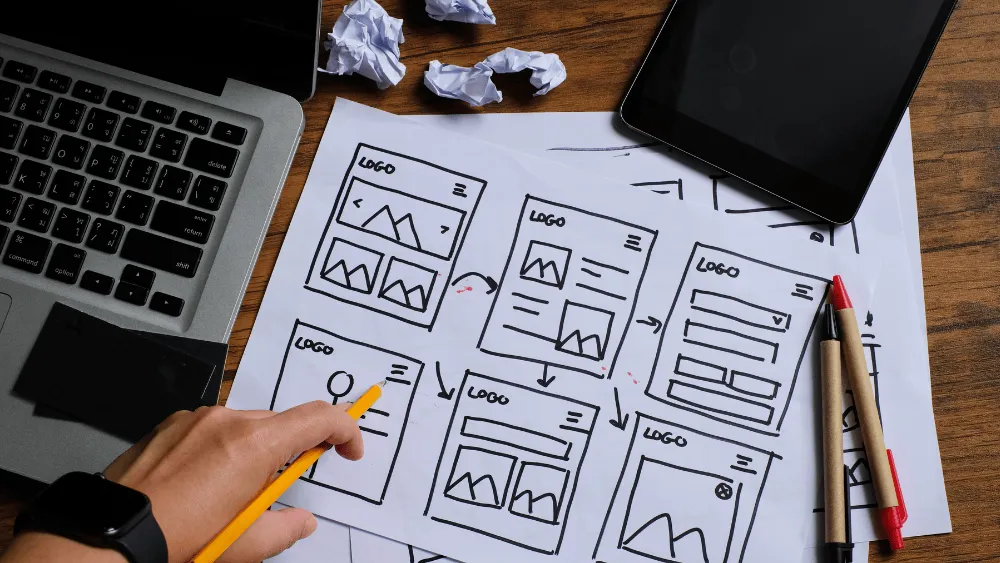
3. Audit the current site before changing it
Begin a website redesign project by identifying what works as well as what fails. Review important pages, enquiries, search performance, links and the tasks people complete. A redesign should preserve valuable content and routes instead of replacing them indiscriminately.
Check the evidence behind a weak metric. A short visit can mean that someone quickly found an answer, while a long visit can reflect confusion. Interpret analytics alongside the page's purpose and actual feedback.
Record an appropriate baseline before launch. Keep definitions and time periods consistent so later comparisons are meaningful. If tracking is incomplete, note that limitation and fix the measurement rather than invent a precise starting point.
4. Create a visual direction that fits the content
A new design should make the business easier to understand. Typography, spacing, imagery and colour can create a more coherent experience, but they need to support the explanation rather than compete with it.
An accounting firm is a useful type of reference for considering how a professional service explains its offer. Study the clarity of the information and the route to contact, not only the visual style.
Use real content in design reviews. Long titles, ordinary paragraphs and varied images reveal whether a layout works beyond the ideal mockup. A page filled with decorative cards may look organised while making a continuous explanation harder to read.
5. Preserve search foundations and established URLs
Inventory important pages and existing links before implementation. Preserve established URLs where practical, particularly pages that already attract relevant traffic or referrals. A visual refresh does not require renaming every slug.
Where a URL change is genuinely necessary, create a specific mapping and test the redirects. Google's site-move guidance warns against sending many unrelated old pages to a single irrelevant destination. Maintain the context of the original journey.
Review titles, indexing settings, canonical information and internal links in the finished site. A development setting left in place can undermine a careful content project. Search behaviour may still change during a redesign, so avoid promises that rankings cannot be affected.
Being willing to pay a website owner to place a link does not make that link a safe ranking strategy. Google's guidance distinguishes appropriately qualified advertising or sponsorship links from links intended to manipulate rankings. Assess the arrangement accurately rather than treat payment as an SEO shortcut.

6. Design for the actual mobile journey
Responsive design is more than reducing the width of a desktop layout. The reading order, navigation and interactions need to work when space is limited and the person is using touch.
Check whether a fixed header, cookie notice and floating action together obscure the page. Review forms with the on-screen keyboard visible. Test whether tables remain understandable and whether images retain the detail needed to explain the subject.
Tools such as Pixefy can be investigated for review and feedback workflows, but no tool label proves that the website works on all devices. Combine relevant checks with actual interaction on representative screens.
7. Make navigation reflect recognisable choices
Use labels that help the visitor predict the destination. A service name such as Web Design may be more useful than a vague word like “Solutions” when it accurately describes the content behind the link.
Group related pages, keep important routes consistent and provide context on deeper pages. There is no universal maximum menu count or number of clicks that makes every site usable. The meaningful question is whether people can find the right information without unnecessary uncertainty.
Review the footer and in-content links as well as the main menu. Someone reading a detailed article may need a relevant next step there, rather than return to the homepage to begin again.
8. Improve performance through specific findings
Measure representative pages and investigate the causes of delay. Large images, heavy scripts and third-party embeds can affect the experience. A more expensive hosting plan will not automatically fix every front-end problem.
Yellowlab is one diagnostic reference to assess alongside other performance tools. Use the findings to identify work, then test the effect of the change. A score should support judgement rather than become the only objective.
Optimise media for its purpose and display size. Lazy loading can help with content further down the page, while an important initial image should not be unnecessarily delayed. Avoid blanket rules that treat every asset identically.
Include performance in the ongoing review of new features. A fast launch can gradually become slower if each campaign adds another script without considering the combined effect.
9. Rewrite unclear copy without losing useful substance
Good website copy answers the questions needed to understand the offer. It should explain the service, its limits and the next step in language the audience recognises. Removing every long paragraph is not the same as improving clarity.
Use headings to show the argument and paragraphs to develop it. Lists work for genuinely parallel items, but a page made entirely of isolated bullets can feel like a checklist instead of an explanation.
Keep evidence accurate. A case study should identify what happened and what the team contributed. Do not add invented percentages, testimonials or client experience to make the redesign feel more persuasive.
Protect content that is already performing well unless there is a clear reason to change it. Its presentation can improve through spacing, imagery and readable tables while the established copy and links remain intact.
10. Make calls to action accurate and proportionate
A button should explain what happens next. “Request a project discussion” sets a different expectation from “Get an instant quote”. Choose wording that matches the destination and the actual service.
Position the action where the reader has enough context to consider it. Repeating a large button after every paragraph can interrupt the explanation and make the page feel pressured.
Test the destination as part of the design. A strong button cannot compensate for a confusing form, a broken link or an acknowledgement that never arrives. The action includes the whole journey, not just its visual treatment.
11. Map the journey through the business response
Trace the route from the first relevant page to the intended outcome. A visitor might read an article, explore a service, review a project and submit an enquiry. Each step should add useful context rather than repeat the same claim.
Include what happens after submission. Who receives the request? What information is available to them? How does the prospect learn what comes next? A redesign that improves only the public screens can leave the operational problem untouched.
Use a hypothetical task to test the route. Ask someone unfamiliar with the site to find a suitable service and explain how they would begin. Their uncertainty can reveal a gap that the project team has stopped noticing.
12. Use images that contribute to the story
A photograph or screenshot should help the reader understand the business, product or process. Real project imagery can provide useful evidence when it is accurate and used with appropriate permission.
Stock imagery can still be suitable for an illustrative purpose, but do not imply that it depicts your team or a completed client project. Captions and context should make the role of the image clear where needed.
Check cropping and legibility across screen sizes. A screenshot with essential text may become unreadable when reduced, while a portrait photograph may need a different treatment from a wide image. The layout should accommodate the content thoughtfully.
Keep alternatives and file preparation in the content workflow. A visually attractive image should not make the page unnecessarily heavy or leave important information unavailable to someone who cannot see it.

13. Add video where seeing the action helps
Video is useful for demonstrations, walkthroughs and explanations that benefit from movement or a person's voice. It is not automatically the most effective format for every page, and placing it in the hero does not guarantee more enquiries.
Keep essential information available in a suitable written form. Plan captions and other appropriate alternatives, and avoid unexpected audio. A person should be able to understand the page even if they cannot or prefer not to play the recording.
Choose duration around the subject. A narrow question may need a short clip, while a complex demonstration may need more time. Remove repetition without cutting the explanation the viewer came to see.
Test the player on the final page, including loading behaviour, controls and the next step. A recording that works well on its own can still be awkward inside a crowded mobile layout.
14. Choose a delivery partner with a clear scope
When researching web design London, review relevant work and ask what the proposed team actually delivered. A polished portfolio is a starting point for questions, not proof that every requirement will be covered.
Discuss content, design, implementation, integrations and testing explicitly. Confirm who provides the copy and images, how feedback is approved and what happens when a requirement changes.
Ask how the site is handed over and maintained. The business should understand account ownership, routine editing and the support route. A good redesign remains useful after the launch conversation ends.
Compare proposals on equivalent scope. A fixed fee, a monthly arrangement and time-based support can all be reasonable, but their assumptions and limits need to be visible.
Decide whether to repair, refresh or rebuild
| Approach | Useful when | Typical focus |
|---|---|---|
| Repair | A specific failure is identified | Restore a broken route or incorrect behaviour |
| Refresh | The structure works but presentation or content needs attention | Improve selected pages and shared styles |
| Rebuild | The current system cannot support essential requirements well | Rework structure, templates or implementation |
A rebuild should have a reason beyond a supplier's preferred platform. Equally, repeated small fixes can become inefficient when the underlying structure prevents the business from making necessary changes. Explain the trade-off in the brief.
Plan marketing around the revised journey
Digital marketing should connect the right audience to the right page. A redesign can improve the destination, but it does not automatically create demand or distribute the content.
Choose activity based on the offer, audience and resources available. There is no universal percentage of a redesign budget that every business must spend on promotion. Define the purpose of the campaign and how its results will be assessed.
Keep messages consistent across channels. If the new site changes the service explanation or enquiry process, update relevant campaign destinations and supporting material. An old advertisement can otherwise set an expectation the new page no longer fulfils.
Check the launch as a complete change
Before launch, review representative pages with final content. Check navigation, forms, tables, media and ordinary error states. Include long headings and less tidy real-world records rather than only the most attractive examples.
Confirm the technical settings that differ between development and production. Test important URLs, any necessary redirects and the routes from existing campaigns. Make sure the people handling enquiries know when the change happens.
Keep a recovery plan appropriate to the work. A visual change, a platform migration and a data transformation have different reversal requirements. Agree who can make the decision if a critical issue appears.
After launch, verify that the main journeys work and monitor the relevant evidence. Record issues and prioritise them by impact. A successful release is the start of operating the new site, not the end of responsibility for it.
A worked example: refreshing a service site without losing its strengths
Imagine a hypothetical consultancy whose articles attract useful visitors, but whose service pages describe an older version of the business. The blog is readable, the URLs are established and the team can publish updates. The main problem is that visitors cannot connect the useful advice to the services now offered.
A full platform migration may be unnecessary. The project could retain the working content system and existing articles while revising service explanations, updating navigation and improving links from relevant resources. The visual direction can become more consistent through shared typography, spacing and image treatment.
Before changing a successful article, identify what needs improvement. A crowded table may need better cell padding and a distinct surface. An image may need a more useful caption. Those presentation changes can make the page easier to read without rewriting the explanation that already performs well.
The enquiry route then needs testing with the revised service content. A visitor should be able to describe the relevant problem without guessing which internal category to select. The team receiving the enquiry should see enough context to respond usefully.
After launch, review the service journeys and enquiry quality alongside the preserved articles. This gives the business a way to assess the focused change. It avoids assuming that replacing every page and interaction is necessary to make the site feel current.
Control content changes during the build
A redesign can take place while the existing website remains active. Articles may be published, service details corrected and campaign pages added during that period. Agree how those changes will be recorded and transferred before the final launch.
Define the source of truth for each stage. If editors continue working in the live CMS, the development copy needs a planned update. If a temporary content freeze is necessary, make the timing and exceptions clear to the people affected.
Check more than the body text when transferring content. Images, captions, metadata, internal links and publication status can all matter. A page count that matches the original site does not prove that every record is current or complete.
Give important existing pages an explicit preservation plan. Record the URL, the content to retain and the intended presentation changes. This is especially useful when a shared template affects many articles at once.
Keep the change set reviewable. Working through manageable groups makes it easier to catch a repeated formatting issue before it spreads. A batch is complete when its saved result has been checked, not merely when the editing operation reports success.
Make the quality review match the actual design
Choose representative content for each shared pattern. A comparison table needs review with long cell text, a narrow screen and keyboard access. An accordion needs a clear trigger, understandable state and a reading order that still makes sense. An image-led section needs enough contrast for the text over it.
Do not rely only on the neatest sample page. Include an article with several images, a long service title and a record missing optional content. These cases reveal whether the template is resilient or merely well composed for a single example.
Keep the distinction between source checks and rendered checks clear. Valid markup and correct links are important, but they do not prove that the final page has good spacing or readable contrast. Review the actual implementation in its surrounding site styles before claiming the visual work is finished.
Record unresolved issues with enough detail to reproduce them. The page, device or viewport, observed behaviour and intended result help the team repair the problem efficiently. Recheck the affected pattern after the fix rather than assume a code change solved every instance.
A considered redesign feels coherent because these small decisions agree across the site. The quality comes from completing the reading and interaction details, not from adding more components to demonstrate that work has been done.
Include the editing team in the final review. Ask them to add a realistic record and correct an existing page using the documented process. If the only person who can maintain the design is the original developer, the handover may need further work. A redesign should support the next ordinary update as well as the carefully prepared launch content.
Review the result against the original problem
Return to the objectives used in the brief. If the goal was clearer service selection, review whether people find the right information and whether enquiries are more appropriate. If the goal was easier publishing, ask the editors to demonstrate the new workflow.
Compare similar periods where possible and acknowledge other changes. Seasonal demand, marketing activity and the audience can affect traffic and enquiries independently of the redesign.
For Fit Design, the useful outcome is a website whose presentation, content and working behaviour support the business more clearly. Keep improving from observed needs rather than schedule another full redesign simply because a fixed number of years has passed.
Primary references: Google's site-move guidance, Google's link-spam guidance and web.dev image-performance guidance. Apply the guidance relevant to the actual changes being made.
Yes. Content, internal links, URLs and technical settings can affect search performance. Preserve established URLs where practical, plan necessary redirects and monitor the result. An experienced supplier cannot guarantee that rankings will never change.
Identify the specific problem first. Clearer copy, better table spacing, useful imagery or a repaired form may address the need. Use a larger rebuild when the existing structure or system cannot support essential requirements well.
Audit the current site, define the intended outcomes and identify content and URLs worth preserving. Agree responsibilities, scope and a review process before detailed implementation.
The cost depends on the content, templates, integrations, migration and testing required. Compare equivalent scopes and separate the project cost from recurring platform and support commitments.
The schedule depends on scope, content readiness, review availability and technical dependencies. Ask for a plan that identifies those assumptions and the decisions needed at each stage, rather than relying on a universal timeframe.




Where ideas come to life
We explore various aspects of modern life, offering valuable perspectives on the latest trends, and helpful tips.

