

Stay updated with our letter
Valuable perspectives on the latest trends and tips.


WordPress Website Cost | Beginner Pricing To Build A Website



A WordPress website has two prices: what it costs to build and what it costs to own. The first covers decisions about content, design and functionality. The second includes hosting, licences, maintenance and the time needed to keep the site useful. Comparing only the launch invoice can hide the larger commitment.
The most useful estimate starts with scope. A small brochure website with approved content is a different project from a shop with product migration, complex delivery rules and several integrations. This guide explains how to compare WordPress website costs in the UK, what to include in a budget and where a cheaper build can create avoidable work later.
What determines the cost of a WordPress website?
WordPress is a content management system: it provides a way to manage content, but it does not decide how your services should be explained or how a visitor should move through the site. Those decisions take time whether the implementation uses a theme, a page builder or custom development.
The main cost drivers are the number of distinct layouts, the quality and readiness of the content, the complexity of the functionality and the testing required. Ten service pages sharing one layout may take less effort than three pages with completely different structures and interactions. Ask for an estimate that recognises that distinction.
Existing content can also change the workload. A redesign may need to preserve URLs, migrate media, clean up duplicate entries and reconnect tracking. None of these tasks is visible in a homepage mockup, yet each can affect the reliability of the launch. Include them in the brief rather than assuming they are covered automatically.
How to build a realistic budget
Use a calculation that separates one-off work from recurring commitments. For an illustrative project, suppose discovery, design and development total £4,000, content preparation costs £600, and hosting plus licences average £35 per month. Add an illustrative £150 monthly support allowance. The first-year budget would be £6,820 before any applicable tax: £4,600 upfront plus £2,220 in recurring costs.
These are example inputs, not verified market averages or a Fit Design quotation. Their purpose is to show why a build price alone is incomplete. Replace them with the actual scope and written supplier costs for your project. If you do the content work internally, the invoice may shrink, but the work still requires someone’s time.
Compare the second year as well. The build fee usually disappears, while renewals, support and new work remain. Check whether introductory software prices increase at renewal and whether licences supplied by the developer remain available if you change provider. A transparent estimate makes those assumptions visible.
| Allowance | Calculation | Total |
|---|---|---|
| Build and content | £4,000 + £600 | £4,600 |
| Annual running costs | (£35 + £150) × 12 | £2,220 |
| First year | Upfront + recurring | £6,820 |
Agency, freelancer or DIY?
Working with a WordPress agency
An agency can be suitable when you need several disciplines brought together: discovery, copy, design, development and testing. The value lies in the work included and how well it is coordinated. A bespoke website should be scoped around your audience and business needs, not described as custom simply because the colours differ from a template.
Ask who will work on the project and which responsibilities sit with your team. Some agencies include content workshops and migration; others expect finished copy and a complete asset folder. Clarifying that boundary helps you compare proposals and avoids paying for delays caused by missing inputs.
If you need a scalable online footprint, discuss how additional services, case studies or locations will be added later. A reusable structure may cost more to plan initially but reduce repeated development work. The proposal should explain that benefit concretely rather than using “scalable” as a general promise.
Hiring a freelance developer
A freelancer can be an effective choice for a focused project, especially when design and content are ready. Direct communication can make decisions straightforward, but the arrangement still needs a clear scope, timeline and testing process. Working with one person does not automatically mean fewer revisions or faster delivery.
Ask how unfamiliar requirements are handled and who covers ongoing support. If the project requires specialist copywriting or complex integration work, establish whether those services are included, subcontracted or your responsibility. A good fit is more important than the supplier’s team size.
Think about cost efficiency over the whole project. A low day rate offers little reassurance if the brief is vague or the website is difficult to edit. Conversely, a well-scoped freelance build can provide excellent value when the requirements match the developer’s strengths.
Building the website yourself
DIY can work for a simple site when you have time to learn and can accept a gradual launch. A theme or page builder reduces some implementation work, but you still need to organise content, choose imagery and test the result. The ultimate website planning guide can help you think through the decisions before starting.
Be honest about the learning cost. Tasks that look minor—configuring forms, fixing spacing on mobile or understanding a plugin conflict—can consume an afternoon. This does not make DIY the wrong choice; it means your budget should include time as well as software.
Consider a hybrid approach. You might prepare the content and manage ordinary updates while hiring a specialist for structure, setup and launch checks. Define that split early so neither party assumes the other has tested an important part of the site.
The ongoing costs behind a WordPress website
Domain name and hosting
Keep domain registration separate from hosting in your budget, even if one provider sells both. Compare renewal terms, account ownership and support arrangements. Providers such as Dreamhost are options to investigate; the right choice depends on your technical needs and the service included, not just an introductory offer.
For hosting, ask about backups, recovery, resource limits and the way support is delivered. “Managed” can cover different responsibilities at different companies. Find out who handles updates and who investigates a problem caused by a plugin, theme or integration.
Do not buy capacity purely on the number of pages. Traffic patterns, dynamic features and the amount of processing required can matter more. A developer should be able to explain the hosting recommendation in relation to your site rather than listing a generic premium plan.
Security and access management
Confirm whether HTTPS certificate management is included with hosting. Then look beyond the certificate: account access, software updates and recovery procedures remain important. An enterprise password manager can help a team manage credentials, but the process should also define who receives access and when it is removed.
Avoid sharing one administrator account across everyone involved in the project. Keep business ownership of key services and document recovery details. This reduces disruption when staff or suppliers change and makes it easier to understand who is responsible for each system.
Security should be treated as ongoing work rather than a badge purchased once. Ask what a support plan monitors, what happens when an alert is raised and whether investigation or remediation incurs a separate fee.
Themes, plugins and page builders
Paid tools can provide useful functionality, but every licence should have a purpose. Record the tool, the renewal cost, the account owner and what happens if it is not renewed. Check whether the developer supplies a licence temporarily or whether your business needs its own subscription.
Elementor, Divi and Oxygen represent different approaches to building and editing WordPress sites. Choose around the editor’s needs and the project architecture rather than a feature count. Avoid treating old price lists as current: plans, renewal terms and included features change.
A smaller, coherent collection of tools is usually easier to understand than several overlapping plugins. Before adding another extension, ask whether the requirement can be met by something already installed. Before removing one, check whether existing content or functionality depends on it.
Analytics and SEO tools
Start with the questions you need to answer. Which pages attract relevant visitors? Are enquiries being recorded? Where do users encounter problems? Tools such as SEObility can support the investigation, but the subscription does not replace interpretation or implementation.
Include the setup and testing of important events in the launch scope. Seeing a tag installed is different from confirming that a successful enquiry is recorded correctly. Check the full journey and distinguish test submissions from genuine activity.
Ongoing SEO work should have a separate brief if it includes research, content production and performance reviews. Installing an SEO plugin does not guarantee rankings. It provides controls that still need accurate content and sensible decisions behind them.
Maintenance and recovery
WordPress upkeep includes attention to updates, compatibility and backups. The official backup guidance explains that both files and the database are needed for a typical full restoration. Ask where backups are stored, how long they are retained and who can perform a recovery.
The maintenance allowance should reflect how frequently the site changes and how important its functions are. A brochure site with occasional edits needs a different arrangement from a busy shop. Page count alone should not determine the level of support.
If you manage routine updates internally, assign responsibility and document the process. Someone should know which journeys to test afterwards and how to escalate a problem. An unassigned task is easily mistaken for a task somebody else is doing.
Agree the content structure and reusable layouts before committing to detailed development.
What custom WordPress development should include
Discovery and content planning
Begin by agreeing who the site serves, what visitors need to understand and what actions matter. Map the main pages and the information each one requires. This stage helps prevent a visually attractive design from being built around placeholder copy that does not match the real content.
Inventory existing URLs, media and integrations during a redesign. Decide what should be retained, improved or removed, and record those decisions. Content migration is not simply copying text: it may involve cleaning formatting, updating references and preserving useful relationships between pages.
Design and development
The design should establish hierarchy, spacing, typography and responsive behaviour. Ask how long headings, missing optional images and different amounts of CMS content will be handled. A layout that works only with the designer’s chosen sample text is not a complete solution.
Custom work can still use established libraries, frameworks or reusable components. “Every line written from scratch” is not a useful quality standard by itself. What matters is whether the approach fits the project, performs reliably and can be maintained by another competent developer.
For integrations, define the source of truth for each type of data. If an enquiry moves from the website to a CRM, document the route and failure handling. Test realistic cases rather than confirming only that an account connection exists.
Testing, launch and handover
Use tools such as Pingdom alongside manual checks. Automated tests can identify problems, but they cannot judge every aspect of usability or content clarity. Test navigation, forms, links, editing workflows and the important screen sizes relevant to the audience.
Agree launch responsibilities before launch day. Identify who controls DNS, who checks the live website and who confirms that enquiries are arriving. If URLs are changing, review the mapping; if they are staying, make sure the implementation preserves them accurately.
Handover should explain ordinary editing tasks and any special dependencies. Confirm the support period in writing rather than assuming a standard warranty applies. Ask what happens after that period and how future changes will be estimated.
Templates: where they save money and where they do not
A suitable template can reduce design and implementation effort when its structure fits your content. It is less helpful when you spend the project removing unwanted features or forcing a complex service into a layout designed for something else. Evaluate it using your real text and images.
For a restaurant, test menus, booking links and opening hours. For property businesses, examine listing management and any required data connections. For a construction company, check whether project pages communicate scope and evidence clearly. The right template is the one that supports the information, not simply the most fashionable preview.
Fitness and beauty businesses may need scheduling or location information; professional services may need detailed capabilities, team profiles and case studies. Retail requirements can extend far beyond a product grid. Identify those needs before purchasing a theme, because additional functionality may require separate tools and work.
Check support terms and compatibility before committing. Keep the licence and purchase details with the business records. Avoid choosing a theme on a historical price quoted in an article when the supplier’s current offering may have changed.
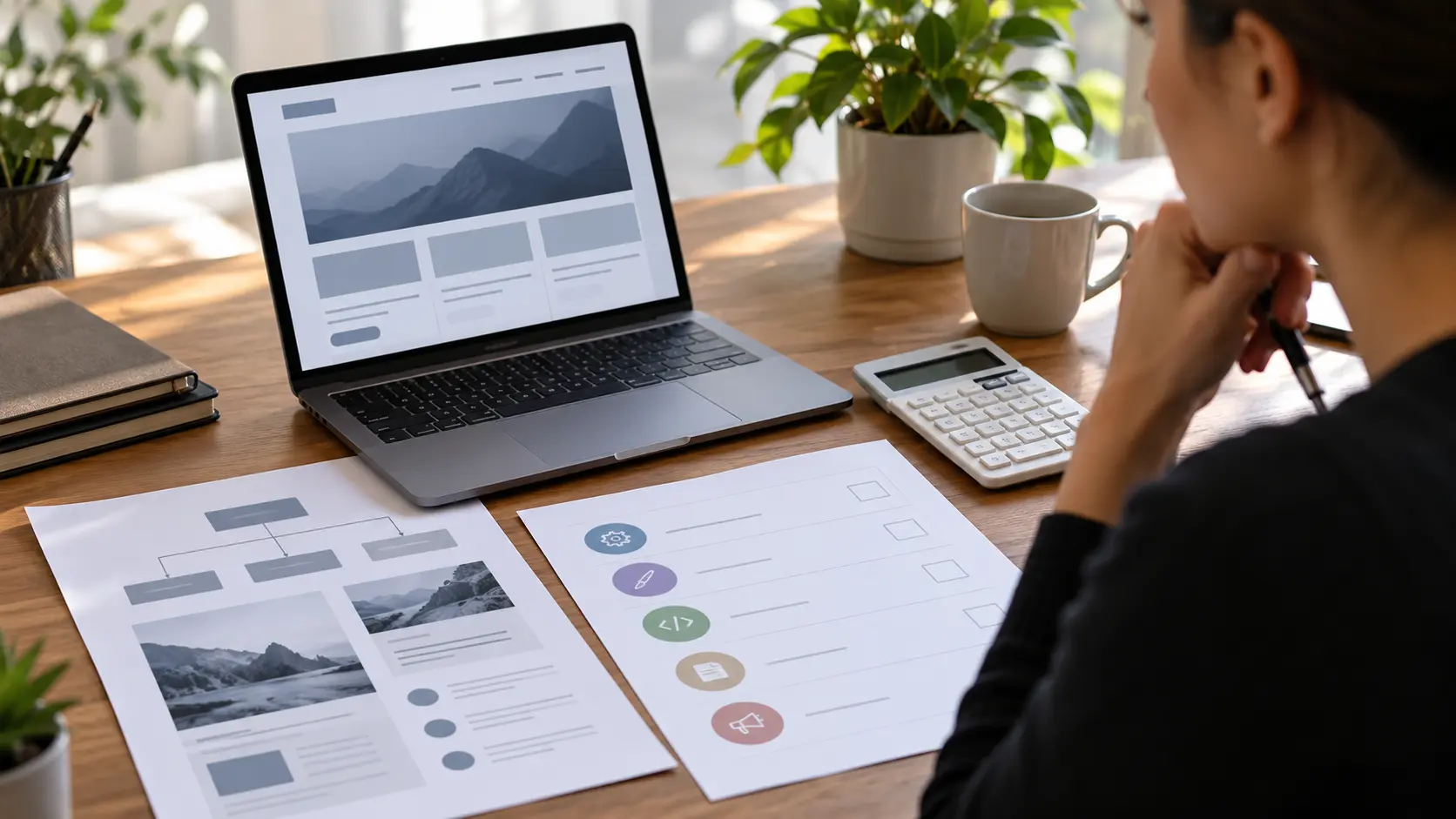
How to compare two WordPress quotes fairly
Put the deliverables side by side. Record the unique layouts, content responsibility, migration work, integrations, testing and handover. Then list recurring costs and exclusions. This makes it easier to see whether a price difference reflects efficiency or simply a different scope.
Ask what could change the estimate. Missing copy, new functionality and repeated changes after approval can all affect delivery. A clear change process allows you to make informed choices instead of discovering additional costs at the end.
Finally, assess whether the proposed site will remain manageable. A lower build fee may be worthwhile if the scope is simple and the handover is strong. A higher fee may be justified by better planning or more complex functionality. Choose based on those details rather than assuming cheap means poor or expensive means excellent.
A budget conversation worth having before design starts
Ask how the estimate treats material supplied late. A developer may reserve time for content entry and testing, but cannot complete those tasks if photographs or approved service descriptions are missing. Agree the handover dates for those inputs, who checks them and how a delay affects the delivery schedule. This is especially helpful when several suppliers are involved.
Keep optional work separate from essential work in the proposal. For example, a basic contact form and a multi-stage quotation tool are different deliverables even if both are described as lead generation. State which one is included and what would trigger a separate estimate. That distinction protects the useful core of the project while allowing you to consider additional functionality when there is a clear business reason for it.
A hypothetical local consultancy might ask for twelve pages, but that number alone is not enough to estimate the project. Six service pages could share one well-planned layout, while a single enquiry page might require conditional fields and a connection to the sales team’s CRM. The estimate should expose those differences instead of attaching the same price to every page.
Take one representative service and one realistic enquiry through the proposed process. Where does the copy come from? Who approves it? Which information must the form collect, and where should the submission arrive? A short discussion of those details can uncover work that would otherwise appear as an unexpected addition halfway through the build.
Content approval deserves a place in the schedule too. If several partners need to review the same page, agree who combines their feedback and makes the final decision. Separate correcting an agreed implementation from changing the brief. This gives both sides a fair way to understand why a revision is included or needs a new estimate.
When you phase a project, keep the essential visitor journey complete. It may be reasonable to postpone an advanced resource library, but a service page still needs a clear explanation and a working next step. Record deferred features so they do not quietly become assumptions in the launch scope.
Finally, ask what successful completion looks like. A finished homepage screenshot is not enough: representative content should be entered, important journeys should work, and the team should understand routine editing. Writing those acceptance points into the proposal turns an abstract promise of a professional website into work that can be reviewed.
Make the budget match the business
The best WordPress budget funds the work your site actually needs. Start with the essential pages and journeys, agree a practical editing structure and make recurring commitments visible. Phase optional features when that allows the core website to launch properly.
If you are discussing a project with Fit Design, bring your current site, content requirements and the problems you need to solve. That gives the conversation a concrete starting point. A scoped estimate is more useful than a generic promise to build a professional website for a headline price.
For recovery planning, consult the WordPress backup handbook. For search fundamentals, use Google's SEO starter guide alongside your project-specific requirements.
The cost depends on scope, content readiness, unique layouts, functionality and migration requirements. Separate the build fee from hosting, licences and support. Use a written estimate for your specific requirements rather than treating a general price range as a fixed quote.
The open-source WordPress software is available without a licence fee, but operating a website can involve hosting, a domain, paid tools and professional work. Distinguish the software from a hosted service or a supplier’s development package when comparing costs.
No. A suitable template can work well for straightforward requirements, while custom design may help when the content or functionality needs a different structure. Judge the result by usability, editing efficiency and maintainability rather than the label alone.
Template directories to investigate include Themeforest, WordPress.com, Creativemarket. Check the current licence and compatibility before choosing a theme.
Allow for hosting, domain renewal, any paid themes or plugins, maintenance and future changes. Check renewal terms and account ownership. An introductory software price or a developer-supplied licence may not describe the long-term cost to your business.
Expect access and ownership information, an editing walkthrough and documentation of important dependencies. Agree responsibility for updates, backups and support. The handover should make ordinary tasks clear and explain when specialist help is needed.




Where ideas come to life
We explore various aspects of modern life, offering valuable perspectives on the latest trends, and helpful tips.

